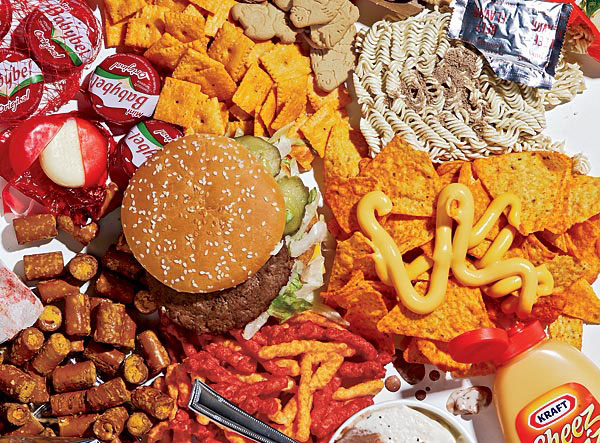
Fast Food = Processed Food
Basically, fast food is
processed food; but what is processed food to begin with? Processed food is
simply food that has been altered in a factory from the way in which nature
presented it, as part of a bulk process where natural and chemical food
additives are added. This leaves the final product without its naturally
created nutrients like vitamins, minerals, and enzymes.
Besides giving the food its
delectable taste, food additives keep it lasting unspoiled for a long time,
which means that processed food is usually stored for a long time before it is
purchased and eaten! The oldest natural food additives are salt, sugar, and
vinegar; and although these are natural, an excess in their amounts seriously
endangers the health.
Junk foods characteristically
contain high amounts of salt (sodium chloride). Sodium is necessary for various
metabolic functions; too much of it, however, is associated with an increased
risk of hypertension (high blood pressure). Hypertension is a known risk factor
for heart disease.
If this is the case with
natural food additives, then how about artificial ones? With the advent of
processed foods in the past thirty years, there has been a massive explosion in
the chemical adulteration of foods with additives.
In his best seller, Fast Food
Nation, Eric Schlosser reveals to the American public very interesting facts
about what they eat. He talks about his experience in a factory in New Jersey
where he discovered how the flavors of McDonald’s food products are fabricated.
Current food processing methods
gather many parts of many animals into one burger. The burger’s beef has to be
deep-fried in oil at high temperatures over 300° C, and this goes for almost
all the popular fast foods that have to be deep-fried, consequently, they
become denatured and possibly even carcinogenic.
Moreover, there is a very
interesting story to tell about the popular McDonald’s French fries exposing
the way they are processed, and the flavors that distinguish them. For decades,
McDonald’s cooked its French fries in a mixture of 7% cottonseed oil and 93 %
beef tallow. The mixture gave the fries their unique flavor and more saturated
beef fat per ounce than a McDonald’s hamburger.
In 1990, amidst a barrage of
criticism over the amount of cholesterol in its fries, McDonald’s switched to
pure vegetable oil. This presented the company with a challenge: how to make
fries that subtly taste like beef without cooking them in beef tallow. A look
at the ingredients in McDonald’s French fries suggests how the problem was
solved. Toward the end of the list is a seemingly innocuous yet oddly
mysterious phrase: “natural flavor”. That ingredient helps to explain why the
fries taste so good.
Food additives interfere with
what we drink as well as what we eat. Let alone the dangers posed by the
chemical ingredients of soft drinks, additives put in the most popular
beverages in the world are quite unsafe. Brominated vegetable oil (BVO) is used
to keep flavor oils present in soft drinks in suspension thus giving the
well-known cloudy appearance to these beverages.
Small residues of BVO are
trapped in body fat, and it has not yet been scientifically proven that BVO is
safe. Bromate, the main ingredient of BVO, is a poison. Just two to four ounces
of a 2 percent solution of BVO can severely poison a child.
Another very ironic fact about
soft drinks is that diet Coke and diet Pepsi are considered the way out for
those who care to have a healthy diet. These people are unaware that instead of
sugar, the artificial sweetener in the diet sodas is acesulfame K. This is
linked to depression, insomnia, neurological disease, and a plethora of other
illnesses; doctors even warn that acesulfame K may be carcinogenic.
We thus see how the
mouth-watering tastes of the much popular American fast food diet are all about
chemicals, artificial flavors and food additives that are added to the food in
the course of a hi-tech manufacturing process.
Fat and Sugar: Obesity Has
Become Phenomenon
Simply put, fast food is high
in fat and sugar – that is to say high in calories – and low in its nutrient
value. Fast food is particularly high in saturated fats, generally preferred by
the food industry because it is cheap and can withstand high cooking
temperatures. It has been scientifically proven that saturated fats are
correlated to cholesterol levels in the blood, and can therefore cause heart
diseases.
While experts state that a
healthy meal should have less than 30% of its calories from fat, with 9 grams
of fat and 270 calories, a McDonald’s hamburger just breaks the 30% ceiling.
Burger King’s hamburger has 15 grams of fat and 320 calories, i.e. 42% of its
calories are from fat. Other famous restaurants’ hamburgers have more calories
and larger percentages of fats.
Thus, hamburgers give us much
more calories than we need and their calories come mainly from fats.
When it comes to sugar, it is
enough to say that the typical can of soda contains an equivalent of 10
teaspoons of sugar.
Fast food thus offers much more
calories than our systems can digest; and these extra calories are stored in
our bodies in the form of fats. Excessive storage of fats in the body leads to
obesity, which does not merely prevent people from looking slim, but it
furthermore predisposes them to many disorders, such as insulin-dependent
diabetes, hypertension, stroke, and coronary artery disease.
More fatally, obesity has been
linked to an increased incidence of certain cancers, notably cancers of the
colon, rectum, prostate, breast, uterus, and cervix.
If fast food and soft drinks
mark the American way of life, then it is easy to understand why more than half
of all adult Americans are overweight. Actually, both scientific studies and
common sense indicate that fast food is the primary reason for obesity.
Consuming junk food does not
only mean eating the chemical food additives that are added while the food is
being processed, nor is it limited to looking fat and getting exposed to
obesity-related illnesses. The problems of fast food are far more diversified.
“No two countries that both
have a McDonald’s have ever fought a war against each other,” says Thomas
Friedman, the well-known globalization theorist, and the Foreign Affairs
columnist.
According to Friedman’s McPeace
theory, McDonald’s might prevent wars; but can McDonald’s prevent the diseases
caused by the junk it serves, such as obesity, diabetes, heart diseases, and
even cancer?
This article is taken from, AboutIslam.
Comments
Post a Comment