
What Happens to Your Body After Death?

Image result for What Happens to Your Body After Death?

Quran Says :
It is He Who gives life, and causes death, and to Him you (all) shall return. (Surat Yunus 10:56). Death is the termination of all biological functions that sustain a living organism. Bodies of living organisms begin to decompose shortly after death.
Biologists now see physiological death as a process, more than an event; conditions once considered indicative of death are now reversible.
Where in the process a biologist draws a dividing line between life and death depends on factors beyond the presence or absence of vital signs.
In general, clinical death is neither necessary nor sufficient for a determination of legal death. Doctors can legally pronounce a person dead without clinical death occurring even if this patient has working heart and lungs, yet suffers a brain death.
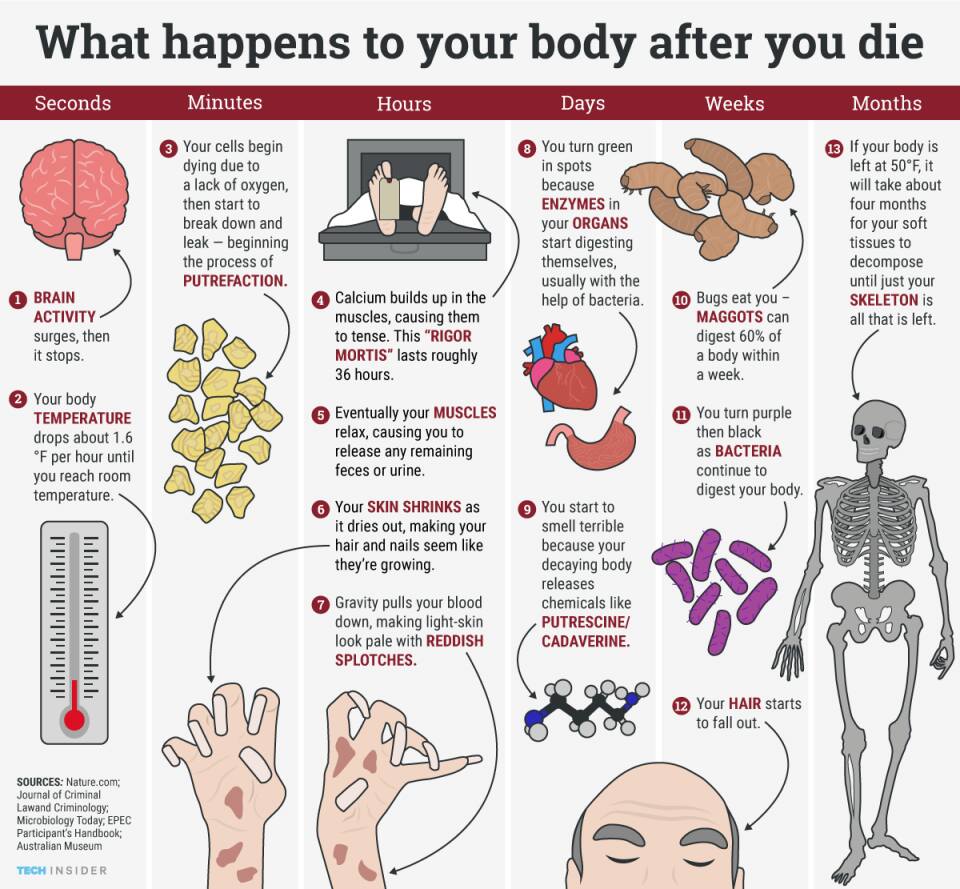

28-10-15_What-Happens-to-Your-Body-After-Death

Comments

Popular posts from this blog

7 Unknown Facts About Hajr Al Aswad Every Muslim Must Know.

The Hajr-e-Aswad also known as The Black Stone is set in the eastern corner of the Holy Kaaba. The Tawaf is started and ended by facing this sacred black stone. Over the years, throughout history, numerous people which included the Prophets of Allah (Peace be upon them) and the Holy Prophet Mohammad (Peace be upon him), the Sahaba (may Allah be pleased with them) and other pious Muslim personalities have performed Hajj and Umrah around the Holy Kaaba and have also placed their blessed lips on the Holy Stone. Today we are going to present some lesser-known facts about Hajr-e-Aswad.[irp] 1-The Hajr-e-Aswad also known as The Black Stone was brought down from heaven (Jannah) and was presented to Ibrahim (peace be upon him) so that he could place it in the corner of the Kaaba. Sunan an-Nasa'i 2935 2-The Hajr-e-Aswad was reportedly stolen from the Holy Kaaba during 930 CE by the Qarmatian warriors. These warriors sacked Makkah while desecrating the Well of ZamZam with corpses ...

Haram or Halal: Bitcoin compliant with Shariah, says research paper

The debate ‘whether cryptocurrency Bitcoin is compliant with Shariah or not’ keeps going on as Islamic rulings abstain one from interest or ‘riba’ on loans and dealing with bitcoin involves interest. A Muslim cleric in December last year had declared that owning bitcoin was compatible with Islamic finance and meanwhile, other scholars disagreed and a fatwa against the cryptocurrency was issued by a top Islamic cleric of Egypt. Matthew J. Martin, the founder of Blossom Finance – Indonesia based microfinance startup – which uses cryptocurrency to help Muslims with Islamic financial law; along with internal Shariah advisor Mufti Muhammad Abu Bakar in a study says ‘Bitcoin is compliant with Islamic financial law’. However, the condition is the local government should not forbid its usage in the region. The founder of the financial firm says there is a widespread confusion among Muslims about cryptocurrencies. “Shariah law is not a single set of rules; it’s is a scholarly field sub...

Valid Reasons for Divorce in Islam

Questions: As-salamu `alaykum. What are the valid reasons for a divorce in Islam Answer: In his response to your question, Sheikh Ahmad Kutty, a senior lecturer and Islamic scholar at the Islamic Institute of Toronto, Ontario, Canada, states: Generally speaking, divorce is not at all viewed favorably in Islam; rather it has been either condemned or discouraged unless warranted by valid reasons. The Prophet (peace and blessings be upon him) cautioned against senseless exercise of divorce when he said, “Among lawful things, divorce is most hated by Allah.”(Abu Dawud) So no one with the sound Islamic spirit and attitude must resort to divorce except in extreme and unavoidable cases, where it has been considered as legitimate in Islam. The reason for this is clear, for divorce entails dire consequences affecting families and individuals; it results in deep psychological and emotional scars, especially when children are involved. Because of such factors and ...